

How To Know If You're Saving Too Much
By Bridget Casey
Many people worry that they might be saving too little for retirement, but in reality, many are saving too much.
In fact, most retirees are actually wealthier 10 years into retirement than the day they stopped working. They retire with their highest net worth ever… and then it just keeps compounding
Most people think about how much they’d like to have by the time they retire, but not many think about exactly what happens after. If you don’t plan for how to manage your money throughout your life, you run the risk of running out life long before your run out of money.
According to Die With Zero author Bill Perkins, your net worth should peak somewhere between age 45 and 60, then gradually decline as you move through retirement and approach your end of life. Your goal isn’t to die with the most money in your bank account, but to convert your money into the experiences you want to have while you’re still alive.
But that’s not how most people design their finances. Instead, the fear of not having enough drives investors to accumulate as much money as they can in their working years, and then hang on to it tightly in retirement. The result? An estate that the CRA taxes generously, heirs who receive money decades after it would have changed their lives, and a long list of trips, experiences, and gestures you kept putting off.
If you retire at 65 with a well-funded RRSP and a maxed-out TFSA, there's a real chance your accounts will compound faster than you withdraw from them. You need to have an intentional drawdown plan for your retirement accounts, or in lieu of that, know exactly when you’re going to stop making contributions well before retirement. Continuing to save and invest long after you need to isn’t responsible, it’s careless. You’re minimizing the life you could have had.
Signs you might be saving too much
How do you know if this applies to you? Here are some things to look for.
1. Your Gilded projection trends aggressively upward in your final decades
If you open your Gilded dashboard and your net worth is still climbing steeply well into your 80s, that's a signal worth paying attention to. An ideal projection looks more like a gentle arc, rising through your peak earning years, plateauing, and then declining gradually as you draw down your savings and enjoy your retirement. While that may be challenging to accomplish, you can still work towards a less aggressive slope. If you see a line that just keeps going up, up, and up, too seemingly mind-boggling heights, it means you're on track to miss out on a lot of life experience.
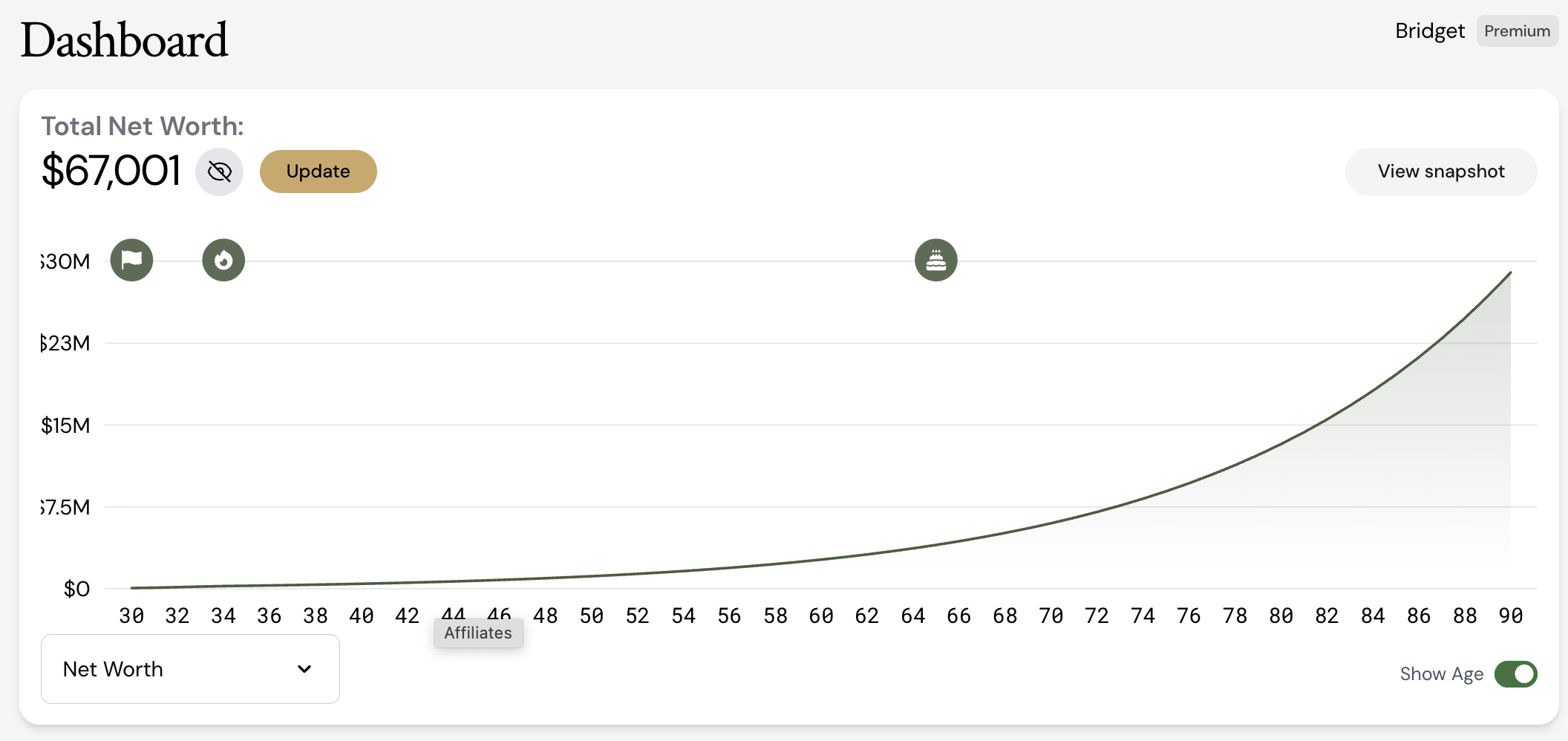
2. You see the RRSP alert on your financial plans
Gilded flags when your RRSP is projected to grow so large that your drawdowns in retirement have you paying a higher marginal income tax rate than you paid during your working lifetime. It’s important to understand the RRSP only benefits you if you make and claim contributions during high income tax years, and then make withdrawals during lower income tax years. If you do the reverse, you’re actually paying more taxes than if you had simply invested in a non-registered account!
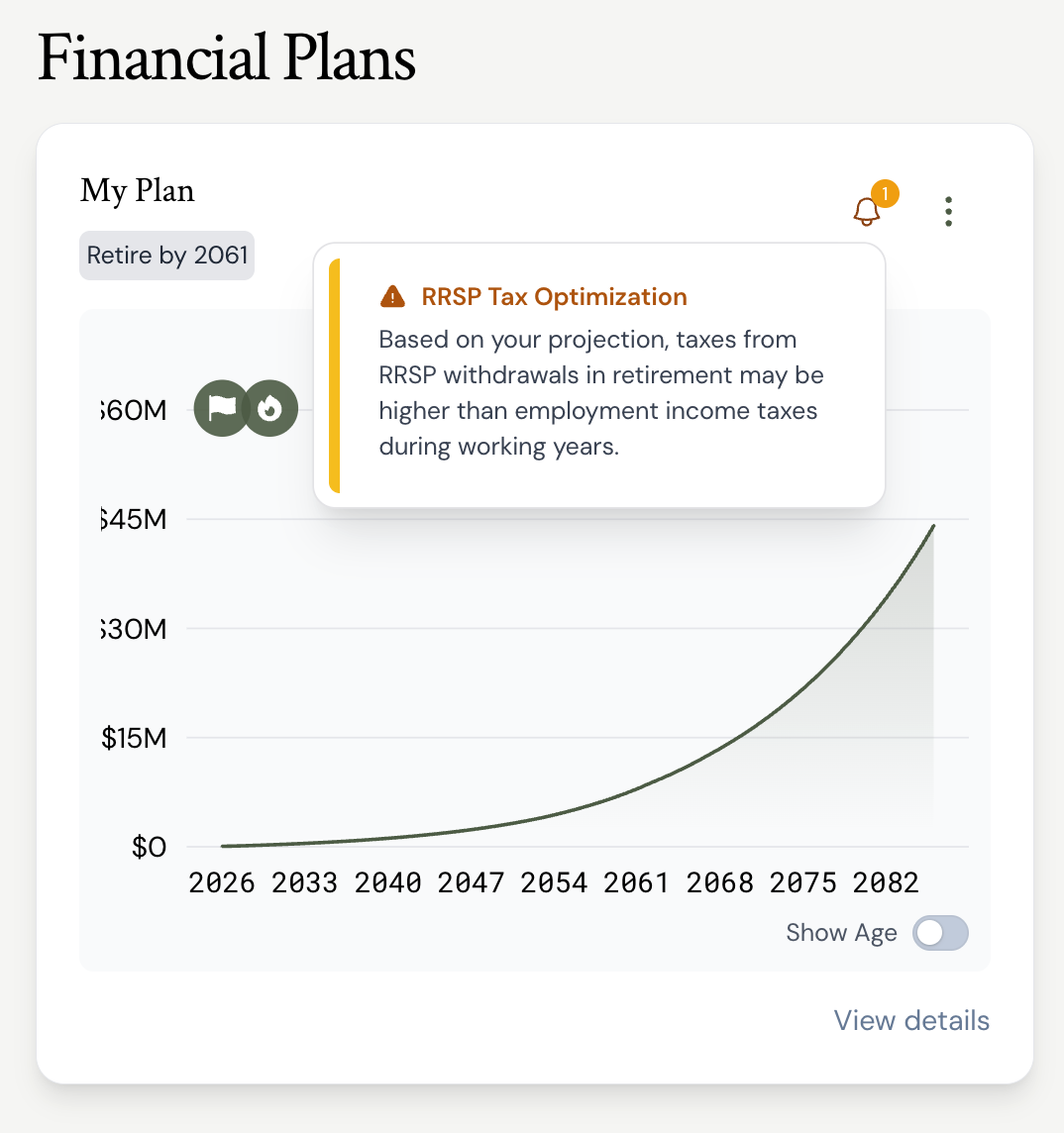
Over-funding the RRSP is actually a common problem for disciplined savers who max out contributions for decades without modelling what mandatory withdrawals will actually look like after age 71. If you're seeing this alert, it's worth modelling some alternative scenarios like making less contributions to your RRSP and/or making withdrawals earlier from the account earlier.
It’s important to keep in mind that at the end of life, the remainder of your RRSP will be liquidated and subject to income taxes in that one calendar year. $500,000 remaining your RRSP at your death becomes a $500,000 income for your estate, which means more than half will be going to the CRA as income taxes.
3. You max out your registered accounts every year but have no drawdown plan
Maximizing your TFSA and RRSP contributions is a great habit. But if your entire financial strategy is "save as much as possible" with no corresponding plan for how and when you'll actually spend it, you're only doing half the work. Accumulation without a decumulation strategy is like training for a race you never intend to run.
The RRSP contribution limit is 18% of gross income up to a maximum contribution of $33,810 for 2026. The TFSA currently has an annual contribution limit of $7,000/year. This means that if your income is less than $400,000/year (as it is for most Canadians!) you’re actually setting aside more than 10% of your gross income. This is fine if you’re late to investing and trying to make up for lost time, or you have an early retirement strategy in mind, but if you’re just investing blindly, you might be putting away more than you need.
4. You feel guilty spending money on things you can clearly afford
This one is less about the numbers and more about the feeling. If you hesitate to book the trip, upgrade the experience, or simply enjoy yourself more, and it’s not because you can't afford it, but because spending feels inherently wrong, that's worth examining. Financial anxiety doesn't always mean you're experiencing financial risk. Sometimes it just means you've never given yourself permission to look at the full picture.
The power of Gilded is we show you what your finances look like right now, and 30 years from now. You can test out big one-time expenses or see what happens when you increase your dining out budget by 50%. If spending more doesn’t derail your financial goals, why not live a little? We want you to have a rich life, not just a rich retirement!
5. Your retirement plan ends at a large number with no plan for what comes next
A retirement target of "$2 million by 65" is a starting point, not a plan. What matters is what you do with it. At what age do you start drawing down? From which accounts, and in what order? What does your spending actually look like at 70, 80, and 90? If you've never modelled the back half of your financial life, you might be optimizing for a number instead of a life.
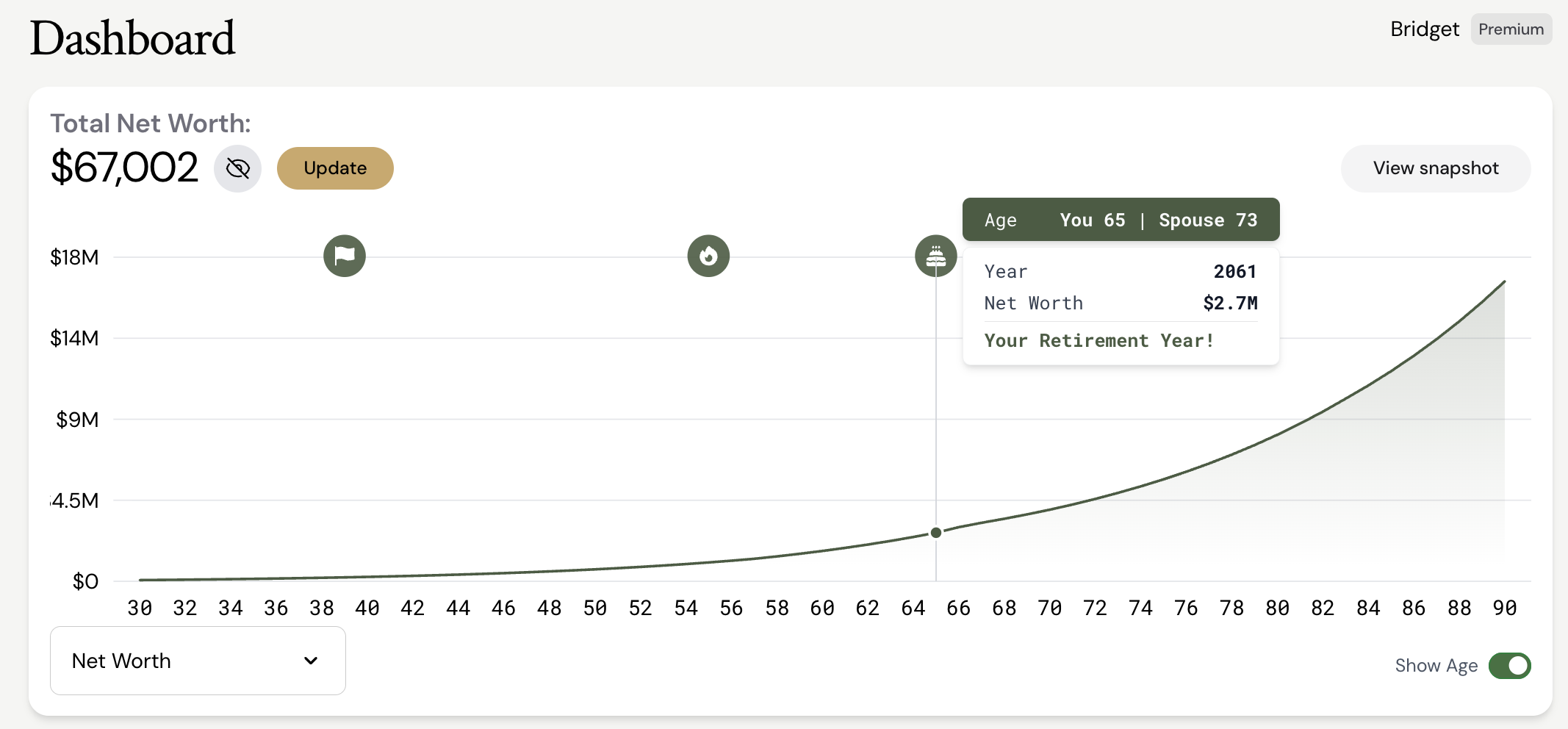
Many Gilded users are shocked by the amount of compounding that happens to their wealth after their retirement. This is because most people tend to retire with the highest net worths of their lives, and often their withdrawals from investments don’t keep up with growth the first 10 to 15 years of retirement. Furthermore, they tend to underestimate CPP and OAS, and are generally unprepared for how much their spending will decrease in their last decades of life.
We tend to imagine retirement as a bizarre combination of expensive travel and expensive long-term care, but the reality tends to be a lot quieter. After you get those bucket list trips out of the way early in retirement, you’ll enter the “slow go years.” Research shows spending actually decreases in your 70’s, and continues to do so until the end of life when it will tick up for the last 5 or so years with long term care costs.
What to do about it
The antidote to over-saving isn't reckless spending, it's intentional planning. This means modelling your full financial life, not just the accumulation phase, and that’s exactly what Gilded is for.
When you can see your entire financial future, you can make better money decisions today. When you have clear estimates of future investment balances, know when your debt will be paid off, and can see how much income you’ll have in retirement, you’ll make better decisions about how you want to spend your time and your money right now.
Ironically, this means so much of the planning is going to happen outside of the numbers. It’s time to ask yourself, what experiences do I really want to have with my limited time on earth? You design your ideal life, and we’ll do the math.
Gilded is more than a retirement planning tool, it’s a life optimization platform. And that’s why we’ll always be encouraging you to run the numbers. Not to get a higher investment balance or lower income tax rate, but get exactly the life you want to live.